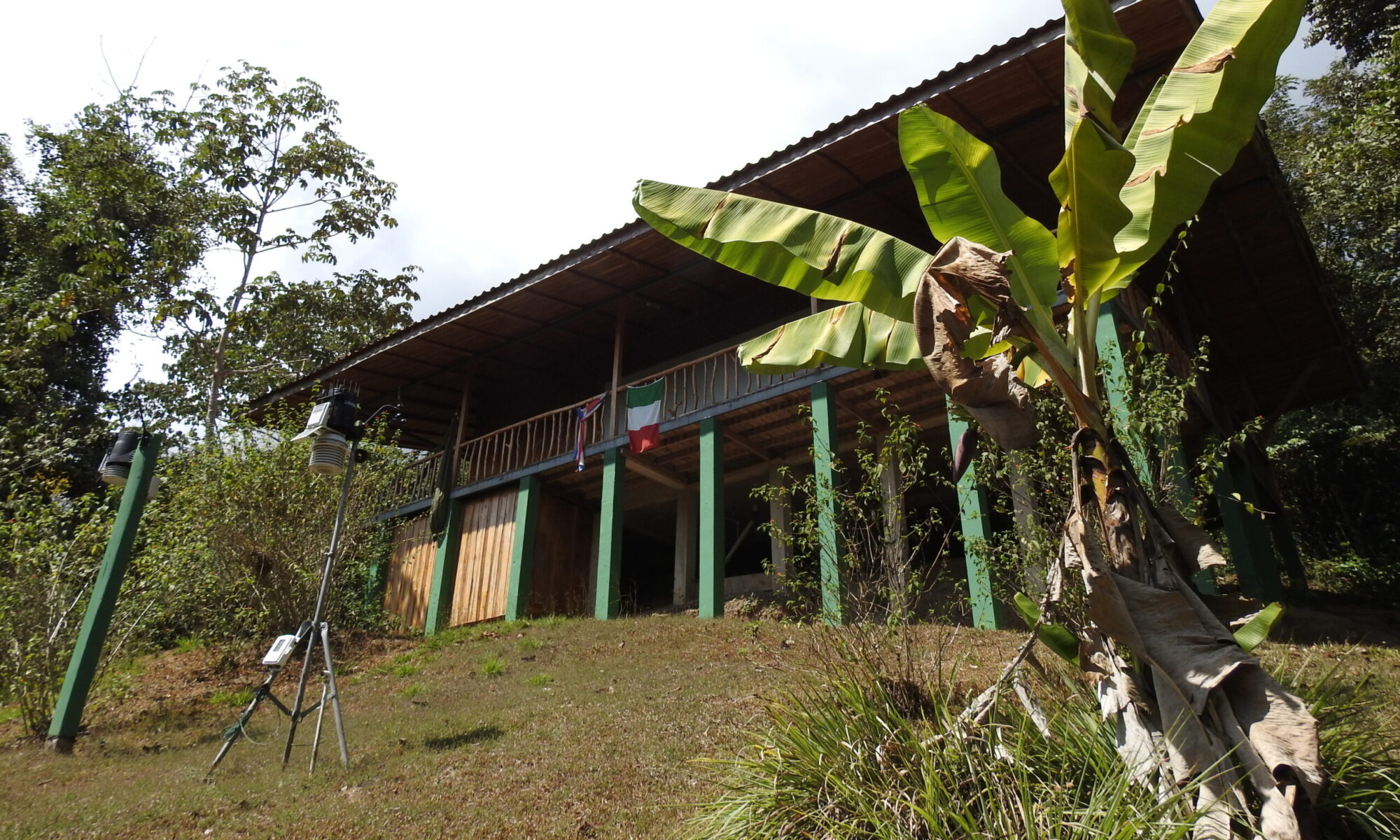

Italia–Costa Rica Meteoclimatic and Biological Station
Karen Mogensen Reserve
Introduction
This annual report summarizes the main meteoclimatic findings recorded during 2025 at the Italia–Costa Rica Meteoclimatic and Biological Station located within the Karen Mogensen Reserve, Costa Rica.
Data collection in 2025 represents a particularly significant achievement: 359 days of data out of 365 are available, with only 6 missing days (January 1–4 and September 26–27). Considering the remote location of the station, together with logistical constraints and tropical environmental conditions, this result constitutes a notable operational success, further strengthening the scientific value of the observational series.
The continuity of measurements remains a fundamental element for the study of tropical climate and for the analysis of its interactions with global climate change, making it essential to continue and strengthen long-term monitoring.
General conditions
The year 2025 was characterized by a weak initial La Niña phase, followed by predominantly neutral conditions, with possible episodes of weak La Niña toward the end of the year. Within this framework, the climate of the Karen Mogensen Reserve retained the typical tropical characteristics of the region, with high and relatively stable temperatures throughout the year and a marked seasonality of precipitation.
From the analysis of the available data, the following summary values emerge:
- Annual mean temperature (Tmed2): 26.1 °C
- Total annual precipitation: 2100.2 mm
Precipitation was mainly concentrated during the rainy season, with high daily variability and the occurrence of intense rainfall events.
Notable events
- Hottest day: March 9, 2025, with a maximum temperature of 35.8 °C
- Coolest day: December 22, 2025, with a minimum temperature of 16.9 °C
- Wettest day: October 4, 2025, with 102.8 mm of precipitation in 24 hours, confirming the high intensity of rainfall events that can affect the area.
On a monthly scale, October 2025 stands out as the wettest month of the year, with 643.2 mm, followed by May (365.0 mm) and June (312.2 mm).
Evolution of the rainy season
In 2025, the transition from the dry season to the rainy season was clearly evident between April and May, with a rapid increase in precipitation starting in May. The most intense and persistent phase of the rainy season occurred between September and October, with very high accumulations and numerous intense rainfall episodes, consistent with regional climatology and modulated by ENSO conditions.
Data quality and instrumental issues
The year 2025 represents a positive benchmark in terms of data continuity; however, some technical issues persist:
- solar radiation and UV radiation sensors show reliability problems, limiting their use for scientific purposes;
- the station as a whole shows signs of obsolescence, making a complete renewal of instrumentation and infrastructure desirable in order to ensure higher observational standards and greater long-term sustainability.
Presentation of the experience at COP30
During 2025, the meteoclimatic and biological monitoring experience of the Karen Mogensen Reserve was presented internationally at COP30, within the side event “Amazon & Heat: Community-First Climate–Environment–Health Action from the Amazon Basin to Africa & Europe”, hosted at the Italy Pavilion.
The side event, organized by Professor Roberto Lucchini, provided an interdisciplinary forum on the links between climate, environment, and health. In this context, the contribution “From Modena, Italy to the Tropics: a journey between forests and planet health” was presented, connecting two complementary experiences of the UNIMORE Geophysical Observatory: the historical observations in Modena, continuously active since 1826, and the measurements conducted in the Tropics in Costa Rica, developed in collaboration with Foreste per Sempre and Asepaleco. The presentation highlighted the role of forests and long-term systematic observations as key elements for understanding climate change and for protecting planetary and human health.
Challenges and perspectives
In light of the 2025 results, several strategic priorities are confirmed:
- Continue measurements, ensuring the continuity of the observational series, which represents the main scientific value of the project.
- Renew the station, with particular attention to radiometric instrumentation and the overall robustness of the system.
- Improve maintenance and management, minimizing periods of instrumental downtime.
- Integrate the station into international scientific networks and projects, strengthening its visibility, sustainability, and scientific impact.
Conclusions
The year 2025 represents a period of great relevance for the Italia–Costa Rica Meteoclimatic and Biological Station at the Karen Mogensen Reserve, thanks to an almost complete data coverage and results fully consistent with the tropical climatology of the area. Observations confirm a climate characterized by high temperatures and strongly seasonal precipitation, with intense events concentrated during the wet season.
The continuity of measurements, together with the need for a structural renewal of the station, is essential to consolidate this project as a long-term tropical observatory capable of contributing to climate change research and to international scientific dialogue.
Prepared by:
Luca Lombroso
AMPRO Meteorologist
Foreste Per Sempre OdV – Geophysical Observatory, DIEF UNIMORE
Modena, Italy

Daily temperature evolution (Tmin, Tmax and mean temperature) in 2025 at the Karen Mogensen Meteoclimatic and Biological Station, Costa Rica.
The graph highlights the characteristic thermal stability of the tropical climate, with limited seasonal variability and a clear annual modulation of minimum and maximum temperatures.

Monthly precipitation totals in 2025 at the Karen Mogensen Meteoclimatic and Biological Station, Costa Rica.
The chart highlights the strong seasonality of rainfall, with maxima between May and October and an exceptional peak in October. Notably, unusual and partly anomalous rainfall occurred during the dry season, especially in January and February 2025, months that are typically much drier.